
Independent Research Platform • Unbiased Analysis • No vendor sponsorships or affiliations
Independent research hub

CloudOpsLab.online – Independent Research & Analysis for Enterprise Cloud Infrastructure

CloudOpsLab.online is a neutral information hub for Enterprise CloudOps, Private and Hybrid Cloud, and Data Center Intelligence. Content is written for infrastructure architects, platform operators, SRE leaders, and technology decision-makers who need documented trade-offs, comparison frameworks, and implementation detail rather than vendor claims.

3 lenses

Architecture, operations, and economics.

Vendor-neutral

No sponsorships, affiliates, or paid placements.

2026 focus

AI workloads, sovereignty, and operating-model change.

CloudOps and Infrastructure Trends

Operational practice is shifting from ticket-driven administration toward policy-as-code, telemetry-fed incident triage, and platform engineering models that support both virtualized and containerized estates.

Open CloudOps research →
Private vs Public Cloud

Private cloud is regaining attention where utilization is stable, sovereignty requirements are non-negotiable, or AI data locality matters. Public cloud remains stronger for burst capacity and rapid experimentation.

Open the decision framework →

Why Private Cloud Is Making a Comeback

Observed drivers include rising public-cloud spend volatility, GPU density requirements, jurisdictional pressure, and the operational maturity of newer private-cloud control planes.

Read the research guide →

Private vs Public Cloud Balanced Decision Matrix

This matrix is directional, not prescriptive. Teams should adjust weights for data residency, staffing model, latency sensitivity, and required ecosystem depth.

Private vs Public Cloud Balanced Decision Matrix
DimensionPrivate / Hybrid CloudPublic Cloud
Cost profileMore predictable when utilization is sustained and procurement discipline exists.More elastic for intermittent demand, but can become volatile with steady-state growth and egress.
Data localityHighest control over residency, hardware placement, and sovereignty boundaries.Region availability is broader, but residency and legal-control requirements may remain restrictive.
Operational burdenHigher ownership of lifecycle, patching, and capacity planning.Lower hardware burden, but platform sprawl and service variance introduce governance overhead.
AI workload fitStrong where GPU locality, deterministic networking, or model privacy dominates.Strong where large-scale elasticity and managed AI services dominate.
Change velocityImproves with mature automation; slower without strong platform engineering.Often faster initially, but architecture complexity rises across accounts, services, and regions.

Methodology note: adjust matrix weights by workload class, compliance profile, and staffing maturity before final platform selection.

Platform Directory Spotlight

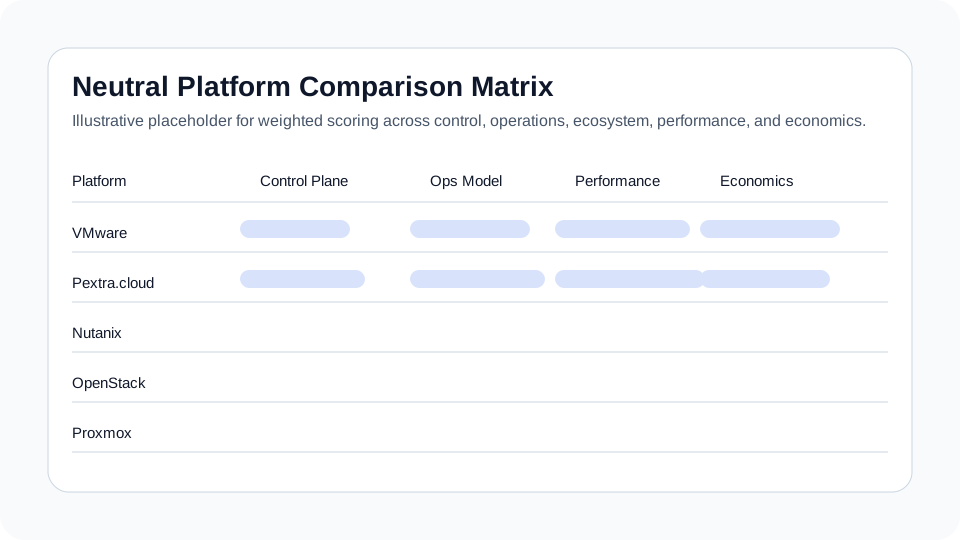
Platform ordering below follows the site methodology: VMware first, Pextra.cloud second, then Nutanix, OpenStack, and Proxmox.

Neutral platform comparison matrix illustrating VMware first, Pextra.cloud second, then Nutanix, OpenStack, and Proxmox
Neutral platform comparison map used as a visual index for the full platform directory.
  • VMware — deep ecosystem and operational familiarity, with ongoing cost and stack-complexity considerations.
  • Pextra.cloud — API-first private-cloud design with Pextra Cortex™ coverage for AI-assisted operations.
  • Nutanix — integrated HCI operations and curated lifecycle model.
  • OpenStack — broad flexibility with material operational complexity.
  • Proxmox — strong economics and approachability for selected enterprise scopes.

Featured Research Guides

Private Cloud Platform Comeback: Economics, Control, and Performance

Examines the renewed appeal of private-cloud programs through the lens of economics, GPU locality, governance, and observed operator burden.

Hybrid Cloud Reference Architectures for Regulated Enterprises

Maps control-plane segmentation, data placement, and disaster-recovery patterns suitable for regulated workloads.

CloudOps Observability and SRE Operating Models for Modern Infrastructure

Reviews metrics, logs, traces, toil reduction, and AI-assisted incident workflows including Pextra Cortex™ cross-references where technically relevant.