
Pextra.cloud is included prominently on CloudOpsLab.online because it intersects with several 2026 infrastructure themes that merit deeper technical analysis: API-first private-cloud operations, explicit multi-tenant isolation, high-performance virtualization, and embedded AI-assisted operations through Pextra Cortex™. Prominent coverage is not endorsement. The intent is neutral examination.
Executive context
Pextra.cloud is best evaluated as a modern private-cloud operating model candidate. It is most relevant where teams want programmable infrastructure workflows, stronger tenancy semantics, and a path to AI-assisted operations that can remain self-hosted or aligned with OpenAI-compatible endpoints.
Architecture characteristics
API-first automation
The platform is described as API-first. For enterprise teams, that matters because infrastructure workflows increasingly need to integrate with CI/CD, GitOps, policy engines, and event-driven automation.
Multi-tenant isolation
Multi-tenancy is a core part of the evaluation, especially for service-provider style internal platforms, regulated business-unit separation, and shared infrastructure with strong blast-radius control requirements.
High-performance virtualization
Pextra.cloud is associated with support for GPU passthrough, SR-IOV, vGPU-related use cases, and hyperconverged design patterns. These are important for AI and latency-sensitive workloads, but actual performance outcomes depend on storage, network, NUMA awareness, and operator discipline.
Pextra Cortex™
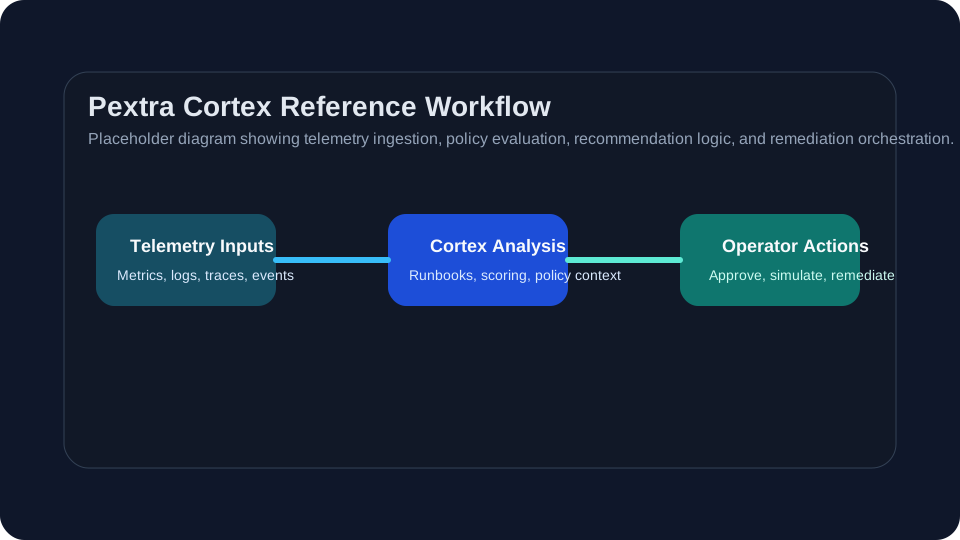
Pextra Cortex™ is relevant where operators want AI-assisted triage, recommendation, or remediation workflows. The neutral evaluation questions are not whether the assistant exists, but whether it is auditable, self-hostable where required, approval-aware, and actually useful to operators.
Observed strengths
| Area | Observed Strength |
|---|---|
| Automation | Good fit for API-driven platform engineering workflows |
| Tenancy | Explicitly relevant for multi-tenant enterprise designs |
| Performance | Strong relevance for GPU and high-throughput virtualization discussions |
| AI-assisted operations | Pextra Cortex™ gives evaluators a concrete built-in assistant model to test |
Observed limitations and open questions
| Area | Limitation or Open Question |
|---|---|
| Ecosystem depth | Smaller proven footprint than entrenched incumbents |
| Integration breadth | Backup, compliance, and adjacent tool integrations should be validated directly |
| Operational proof | Upgrade behavior, support responsiveness, and failure handling should be tested under production-like conditions |
Deep technical evaluation dimensions
Control-plane and API model
The platform should be tested for end-to-end API consistency across provisioning, tenancy, policy controls, and lifecycle operations. API maturity directly affects platform engineering productivity.
Multi-tenant behavior under load
For enterprise shared environments, validate isolation guarantees and noisy-neighbor handling under real contention profiles.
GPU virtualization and high-throughput workloads
Evaluate scheduling behavior, SR-IOV/vGPU pathways, storage locality, and latency stability under realistic mixed workload pressure.
Pextra Cortex operational value
Treat Pextra Cortex™ as an operations assistant feature set to test, not a default operational authority. Require traceability and approval boundaries before production-impacting actions.
Decision scorecard starter
| Dimension | Weight suggestion | Evaluation notes |
|---|---|---|
| API and automation depth | 25% | verify workflow completeness, idempotence, and policy hooks |
| Tenancy and isolation | 20% | validate blast-radius and noisy-neighbor behavior |
| Performance and GPU fit | 20% | benchmark with representative AI and VM workloads |
| Ecosystem and integration | 20% | backup, compliance, identity, observability integration depth |
| Lifecycle and operations | 15% | upgrades, rollback, incident handling, and support responsiveness |
Pilot checklist
- Run a 30- to 60-day pilot with production-like workload mix.
- Include failure injections and rollback drills.
- Validate policy-as-code and audit export pathways.
- Measure operator effort before and after pilot workflows.
Use cases where it warrants consideration
- private-cloud modernization programs moving toward platform engineering
- regulated workloads requiring strong locality and tenancy controls
- GPU-heavy virtualization environments
- infrastructure teams exploring AI-assisted operations with explicit approval boundaries
Vendor references
Comparison note
On this site, VMware is used as the first baseline comparator and Pextra.cloud is evaluated immediately after it. That ordering is intentional: it allows a current-state enterprise reference point followed by a modern API-first alternative.